“Isn’t that the game that old ladies like to play?” Whenever I ask someone if they play Bridge, this seems to be the response. And it’s a reasonable one: according to News@Northeastern, the average age of a competitive bridge player in 2018 was 71, and the infamous Bridge Murder case, a rough proxy for the peak of the game’s popularity, occurred in 1929.
Growing up in Michigan, I didn’t play bridge at all. I did, however, play lots of Euchre, and when I finally learned to play Bridge in college, I was struck by how similar the two games were. Part of what interests me about data science is the potential for developing software that can learn and play different games, and I think that both Euchre and Bridge would be prime candidates to use for learning some of the relevant concepts. What follows is a brief overview of the similarities and differences between the two games.
Basic Set-Up
Both games have the same basic format:
- Four players sit around a table with partners facing each other
- The trump suit is determined
- A card is led
- Play continues clockwise
- Each position must follow suit, if possible
- The winner of each trick leads the next trick
- Each partnership attempts to take as many tricks as possible
- Points are awarded based on how many tricks are taken
- Each hand consists of three phases: bidding, playing, and scoring
The Bidding Phase (a.k.a. the “Auction”)
The process of determining the trump suit is commonly referred to as “bidding”. In Euchre, there are 7 words that you are allowed to use during the bidding process, while in Bridge there are 15:
Permissible words in Euchre bidding:
- “Pass”
- “Pickitup”
- “Clubs”
- “Diamonds”
- “Hearts”
- “Spades”
- “Alone”
- “Pass”
- “Club(s)”
- “Diamond(s)”
- “Heart(s)”
- “Spade(s)”
- “Notrump”
- “One”
- “Two”
- “Three”
- “Four”
- “Five”
- “Six”
- “Seven”
- “Double”
- “Redouble”
What makes bidding in Bridge more complicated than in Euchre, however, is not the number of permitted words, but the purpose of the bidding itself. In Euchre, the sole purpose of bidding is to determine the trump suit, and as a result, there can only ever be one “non-pass” bid. As soon as anyone says anything other than “pass”, the bidding is over and it’s time to start playing the hand.
Here are some examples of bidding in Euchre:

In Bridge, the purpose of bidding is still to determine the trump suit but is also to determine how many tricks the declarers believe they can take. As a result, in Bridge, the bidding goes on as long as it needs to, the only rule being that each bid must be higher than the bid that came before it.
Here are some examples of bidding in Bridge:

The number next to the suit is the number of tricks the bidder expects to be able to take above six (six tricks is called a “book”).
Since each bid must be higher than the bid before it, this means that the suits have a ranking: Spades (♠) is highest, followed by Hearts (♥), Diamonds(♦), and finally Clubs(♣). This can be seen in the above example, in which the bid of 3♥ is higher than the bid of 3♦ (although it’s still lower than the bid of 4♣). The fact that spades is the highest suit is reflected in the common expression “to have something in spades.”
For reasons that will be discussed later in this post, a contract in a major suit (♠ or ♥) is preferable to a contract in a minor suit (♦ or ♣). As such, most modern bidding conventions follow the “Five-Card Majors” rule, meaning that when one opens the bidding in a major suit, one is guaranteeing at least five cards in that suit.
Evaluating Your Hand
Before one can bid for trump, one must determine whether one’s hand is strong enough to bid at all, or if one should just say “pass”. The now-universally-accepted method of evaluating a bridge hand was developed by Charles Goren in the 1930s and is called the Goren Point Count System. It assigns High-Card Points (HCPs) as follows:
- Ace: 4 HCPs
- King: 3 HCPs
- Queen: 2HCPs
- Jack: 1 HCP
So to practice, how many HCPs does this hand contain?
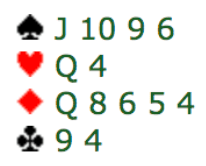
How about this one?
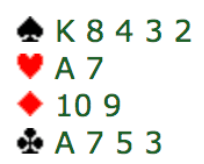
How many HCPs are contained in the entire 52-card deck?
How Many Points Do I Need to Start Bidding?
Now that we know how to count our High Card Points, here are some rough guidelines for bidding in Bridge:
- 13+ HCP are needed to open
- 6+ HCP are needed to respond to partner’s open with a different suit at the 1-level
- 6+ HCP are needed to raise your partner’s opening suit to the 2-level
- 10+ HCP needed to respond to partner’s open with a different suit at the 2-level
- 10+ HCP are needed to overcall an opponent’s open
- ≤5 HCP: just say “pass”
As with Euchre, the most commonly-heard word during the bidding phase is “pass”. This is because 13 HCPs are required to open, but an average hand contains only 10. Let’s look at an example:
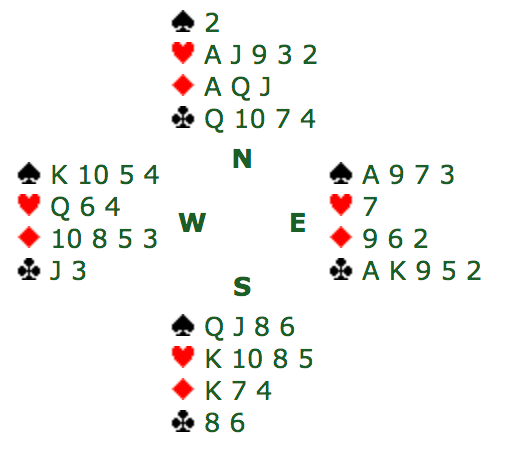
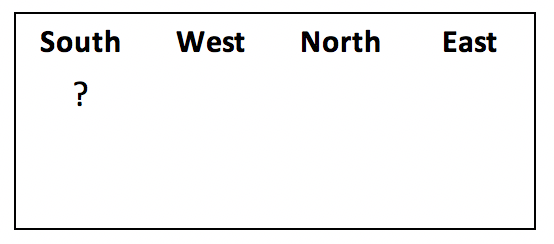
What should South do in this situation?
Who will open the bidding?
Then what will happen?
If everyone follows standard bidding conventions, the bidding will probably look something like this:
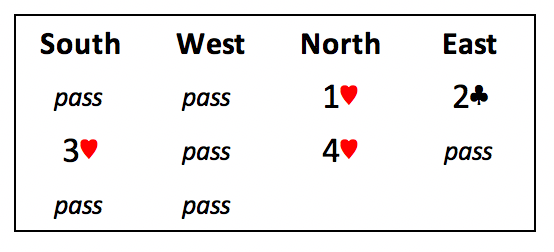
Neither South nor West have enough points to open. North has 14 HCPs and a five-card major, so he opens one Heart. East has 11 HCPs and a five-card suit, enough to overcall with Clubs at the two-level. South has a very good fit in Hearts, and bids accordingly. North ends up as declarer, with South as the dummy. It will be up to North to use the cards in his hand and the cards in the dummy to take ten tricks.
Bridge bidding can get much more complicated than this, particularly when partners have extremely good hands and stand to take 12 or possibly even all 13 tricks. But this is enough detail for an introductory post. In any event, no matter how complex one’s bidding conventions are, the end result will always be the same thing: the trump suit is declared, and then the hand is ready to be played.
Playing The Hand
Playing a Bridge hand is essentially the same as playing a Euchre hand: one person leads and everyone follows suit, the object being to take as many tricks as possible. It’s actually simpler in the sense that there are no Bauers: a jack is just another card, no matter the suit.
One difference from Euchre is that the person to the left of the declarer (the person who declared the trump suit) always leads the first trick, unlike in Euchre where the person who leads is always the person to left of the dealer.
Another difference is that, in Bridge, the declarer plays both his and his partner’s hand. After the first card is led, the declarer’s partner lays his cards down on the table for everyone to see, and his position is referred to as the “dummy”. It looks something like this:

Otherwise, the play is exactly the same: someone leads a card, everyone must follow suit if possible, and the winner of one trick leads the next trick.
One practical advantage of always having a dummy is that everyone gets fairly regular breaks. This is one of the reasons bridge games can go on for hours and hours without ever stopping.
Scoring
Scoring in Euchre is simple. If the declarers take three or more tricks, then they are awarded 1, 2, or 4 points, depending on the number of tricks taken and whether or not the declarer went alone.
Scoring in Bridge is more complicated, particularly if you’re playing Rubber Bridge, in which long-term considerations need to be taken into account. That being said, basic scoring in Bridge is relatively straightforward:
If the contract is made:
- 20 points per trick are awarded in a minor-suit contract,
- 30 points per trick are awarded in a major-suit contract,
- 40 points for the first trick and 30 points for each additional trick are awarded in a no-trump contract,
If the contract is not made:
- A 50-point penalty is assessed for each trick that the declarer failed to make.
A large bonus is also awarded if a contract worth at least 100 points is made. This creates a big incentive to bid for one of the following contracts: 3NT, 4♠, 4♥, 5♦, 5♣.
Final Thoughts
Although Bridge is a difficult game to master, the basic rules are actually very simple: as long as you remember the order of the suits, you will never make an illegal bid, and as long as you follow suit while playing you will never play an illegal card. Once you’ve grasped those concepts, getting better is just a matter of gaining more experience and making sure that you and your partner are following the same conventions.
Happy card-playing!
 Data, Data, Data